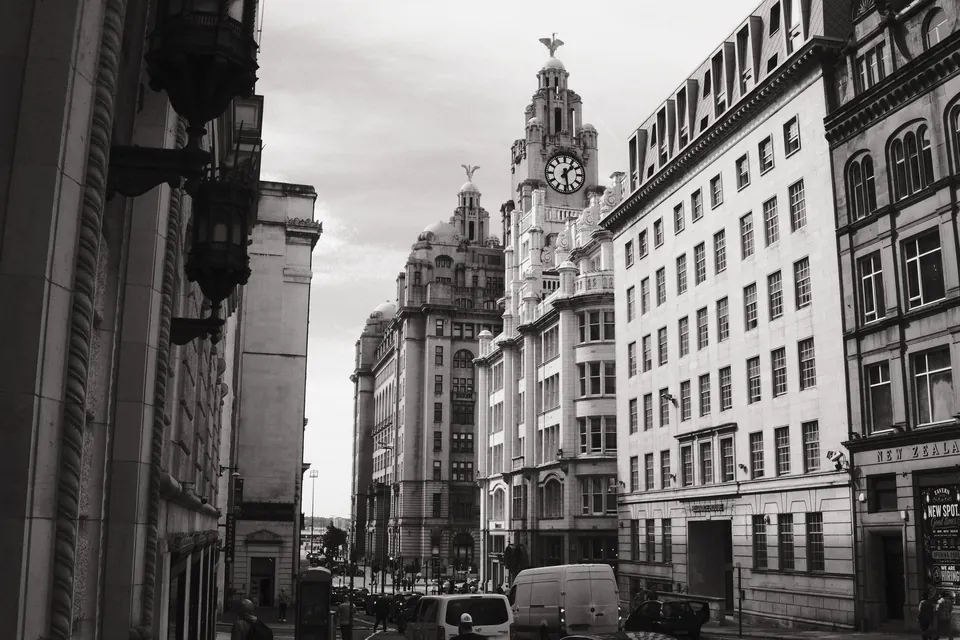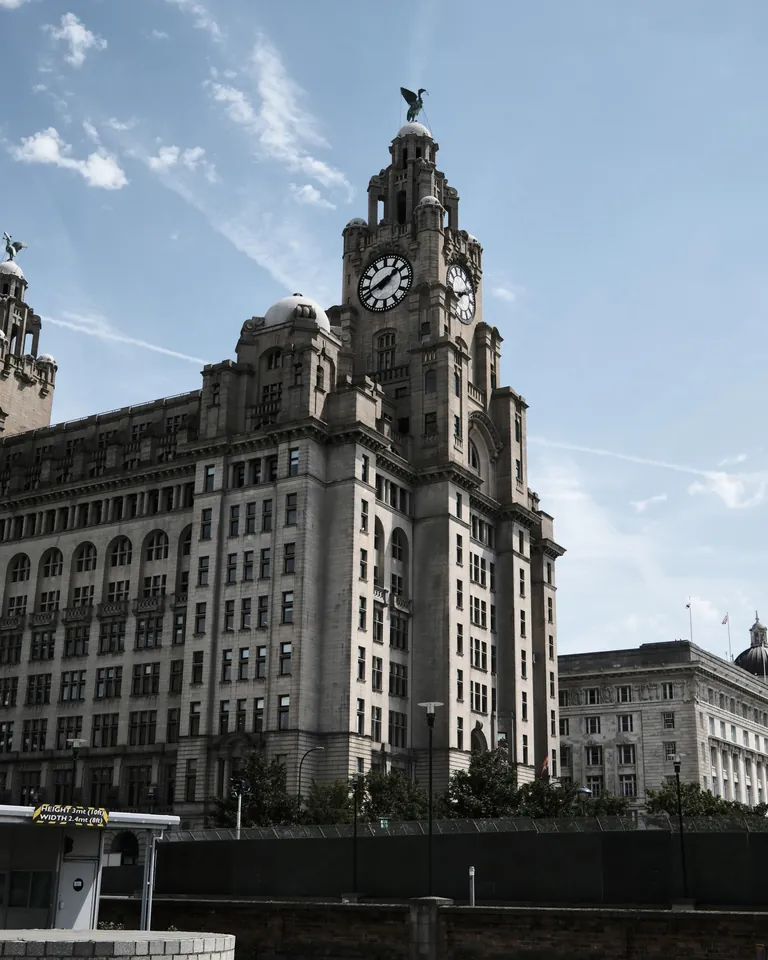
The Royal Liver Building opened in 1911 as the headquarters of Royal Liver. The building’s visitor history traces the organisation back to the Liverpool Lyver Burial Society, founded in 1850. The familiar outline began as a place with a practical institutional purpose, rather than as a ready-made postcard.
Recognition is only the first look
Recognising a landmark is quick. Looking at it takes longer. Where does its bulk meet the street? Which part catches the light? What happens when a person crosses the foreground and changes your sense of its scale?
For our photography, those questions are more useful than trying to remove every trace of the city around the building. Traffic, weather and a partly obstructed view can locate a picture in everyday life. They do not automatically spoil it.
Pair a ground with a city
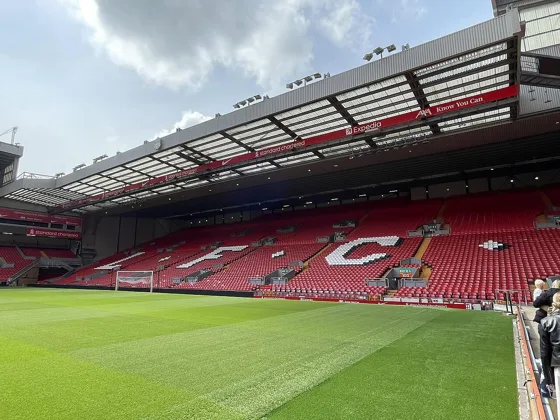
An Anfield picture and a waterfront picture can belong together without using the same composition. One might contain a dense crowd and the other a single figure. One might be close and textured, the other distant and spare. Their connection can come from the viewer’s life rather than a matching visual formula.
That is the approach behind the Liverpool work being prepared for Mark C Grant’s studio. We will show finished photographs when they exist, with their own captions and dates. A promise of a collection is not an excuse to pass off a generated view as a photograph made on the street.
Write a caption that earns its place
A caption should add something the image cannot tell you alone: where the photographer stood, when the exposure was made, or what prompted the choice. “Iconic Liverpool” does little work. A precise observation gives the viewer another way into a familiar subject.
The building will remain recognisable. The challenge is to make the photograph worth a second look.
Reading & sources
What is your take?
Which city view belongs beside an Anfield photograph in your home?
Join the conversation →Keep reading
A name bigger than a stand.
The Kop’s story includes a new terrace, a war and a name whose beginnings are still debated.
The city comes with it.
Anfield, the Liver Building, the streets between. There is more than one way to picture belonging.