CITY HISTORY / A BIRD WITH PREVIOUS
Before there was a Kop to sing from, before either half of the city had a football club to argue about, Liverpool had a bird. It has been an official mark, an uncertain species, a rooftop giant, a souvenir and a badge over the heart. That is quite a shift for something nobody can agree how to identify.
The Reds wear it with pride. The Blues are entitled to remind us that the city existed before our trophy cabinet. There: one point conceded, nobody injured. What makes the Liver Bird worth a proper look is precisely that it connects football to a much older, wider Liverpool.
First came the paperwork.
King John’s charter created the borough in 1207. The 1229 charter under Henry III allowed a guild and a common seal; the earliest surviving impression of Liverpool’s medieval seal is dated 1352. Those dates describe different things. A charter is not a surviving picture of a bird, and a later impression cannot give us an exact carving date.
The seal’s bird is generally interpreted as the eagle of St John the Evangelist. Its sprig and other marks have been read as royal and Plantagenet references. But interpretation matters here: centuries of retelling have encouraged more certainty than the drawing deserves. Wikipedia’s overview is a useful map to the evidence, especially because it links the competing historical accounts rather than pretending none exist.
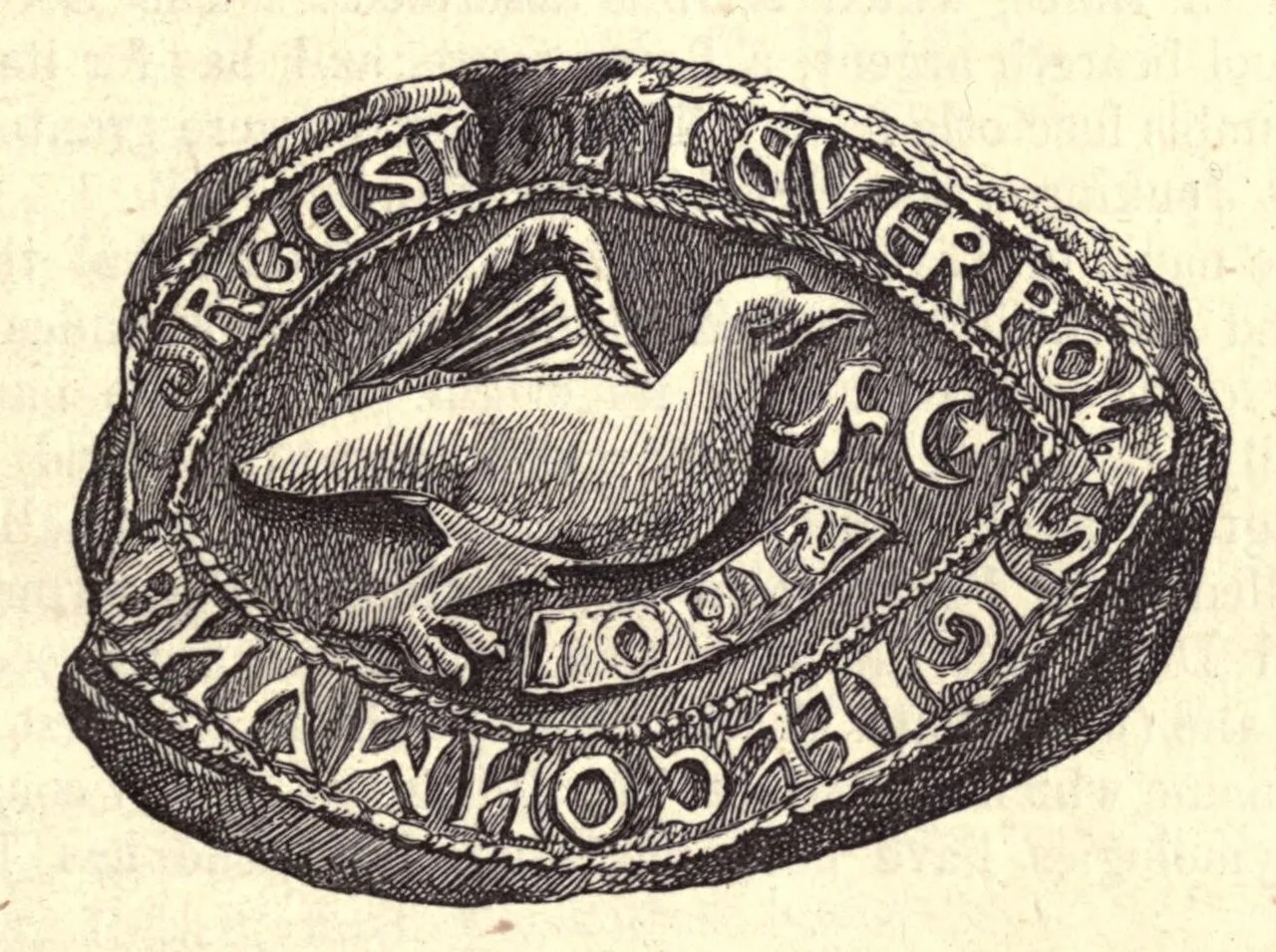
Look at the reproduction above. This is a nineteenth-century rendering of a medieval seal, not a photograph taken in 1229. The bird sits within a little world of lettering and symbols. It was doing administrative work: identifying a community and giving its documents authority. Its first job was closer to signing the paperwork than selling the replica shirt.
A cormorant? An eagle? Steady on, David Attenborough.
J. Wall’s historical study, The Quest for the Liver Bird, follows a changing emblem through seals, civic records and earlier scholarship. Wall argues for an origin in St John’s eagle and a later cormorant identity. He also warns against the attractive circular story that Liverpool was named after a bird called a liver.
That is a historical argument, not the discovery of a previously unrecorded animal nesting behind the Town Hall. The Museum of Liverpool’s trail takes a pleasingly practical approach: compare the objects. Different Liver Birds have different legs, feet and proportions. Its explanation combines eagle, cormorant and other bird features.
There is no need to pick one silhouette and declare every earlier maker wrong. Symbols are remade for their materials and purposes. A tiny stamp has to be legible. A carved plaque needs recognisable shapes. A bird on a tower has to hold its own against a huge sky. The family resemblance matters more than passing an ornithology exam.
A port city, without the postcard amnesia.
A waterside bird feels right for Liverpool because the river is so central to how the city sees itself. Yet the comforting phrase “maritime heritage” can smooth the rough edges off what the port actually did. The International Slavery Museum’s collection account describes Liverpool’s dominance of the transatlantic slave trade in the later eighteenth century and the civic and private wealth extracted from it.
This does not make every building the same story or establish a particular funding claim about the Royal Liver Building. It means that a serious account of the city’s waterfront cannot describe only brave departures, handsome ships and fortunes made. The view holds exploitation as well as ingenuity, movement and work. We can love the skyline and still look properly at the history underneath it.
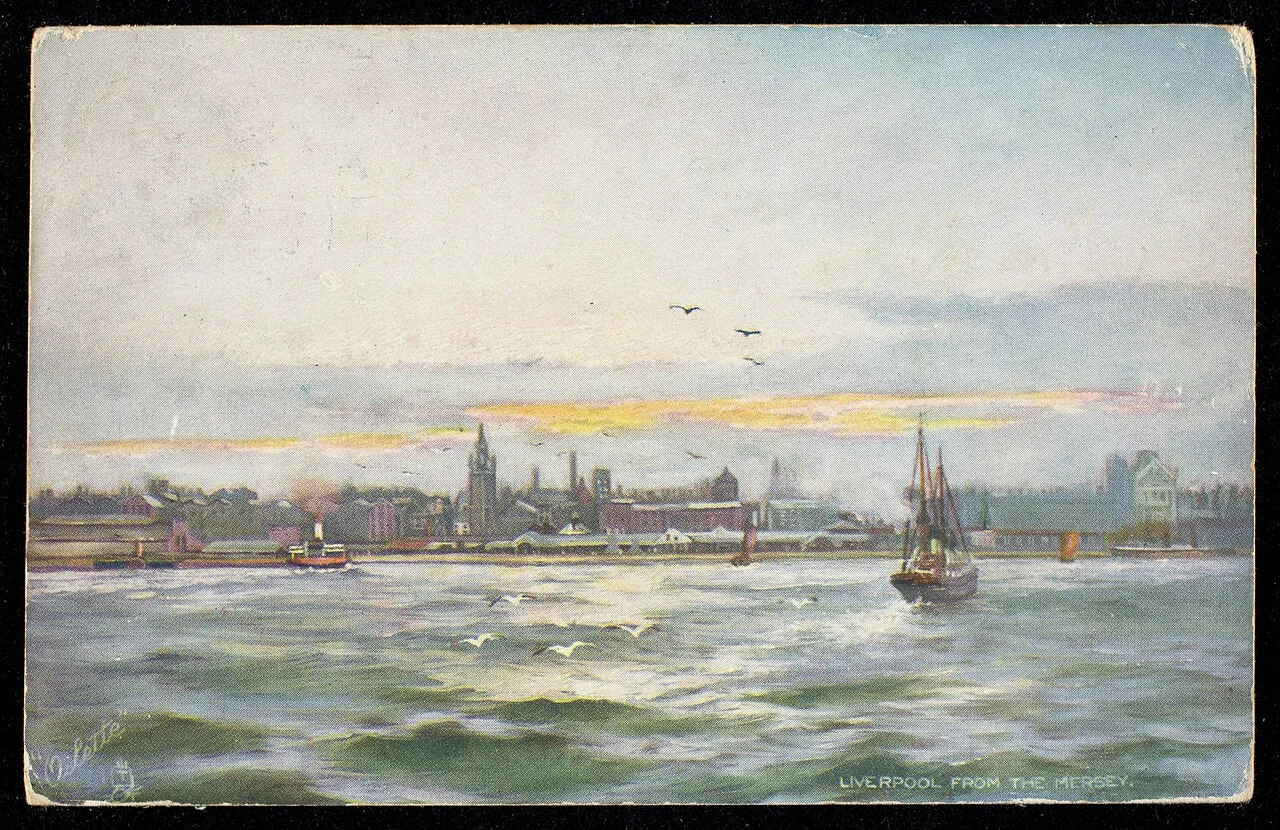
The vintage postcard is another interpretation of the city: a selected view, made to circulate. Compare its waterfront with a photograph now. Look at what occupies the foreground, what the maker thought worth including, and how the water makes the whole place appear as one composition. A postcard is evidence of a view; it is never the whole city.
The big building began with a small contribution.
The building’s own historical timeline starts in 1850 with working men founding the Liverpool Lyver Burial Society at the Lyver Inn. That origin matters: behind the monumental headquarters was a society concerned with provision for death and burial. The skyline came later.
The decision to build on the George’s Dock site was taken in 1907, the foundation stone followed in May 1908, and the headquarters opened in 1911. Historic England lists the building at Grade I and identifies its architect as Walter Aubrey Thomas. Its reinforced-concrete construction belongs to a modern engineering story, even when the stone frontage makes the place look as though it has always been there.
The chronology is worth keeping straight. The bird is older than the building. The organisation is older than its waterfront office. The concrete frame is modern for its time. Folding those into a single misty “ancient Liverpool” story loses the interesting bit: people kept making something new out of things they had inherited.
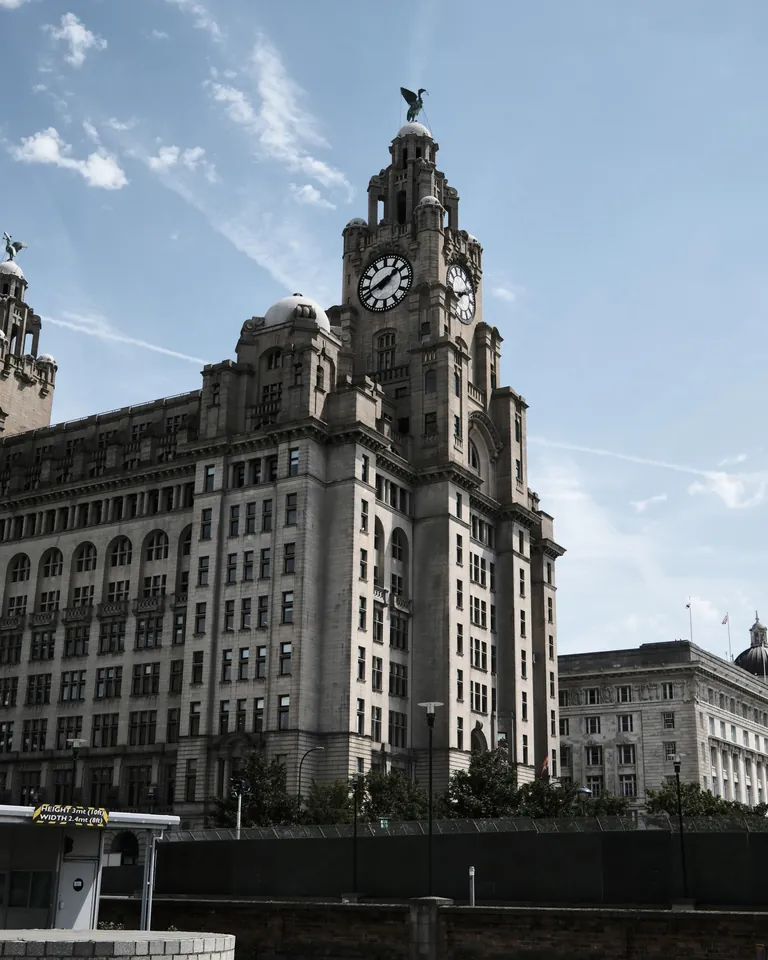
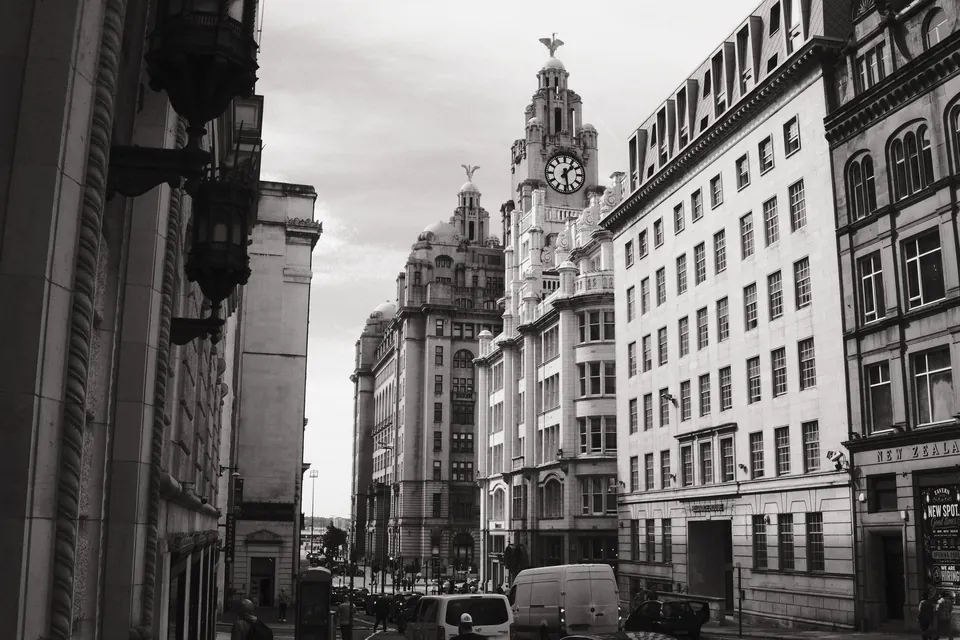
Mark C Grant’s photographs bring the building back into the streets around it. In the opening Water Street view, neighbouring façades frame it; here, sunlight opens up the frontage. These are two approaches to the same landmark, with ordinary street life still in the picture.
Remember the man who made the birds.
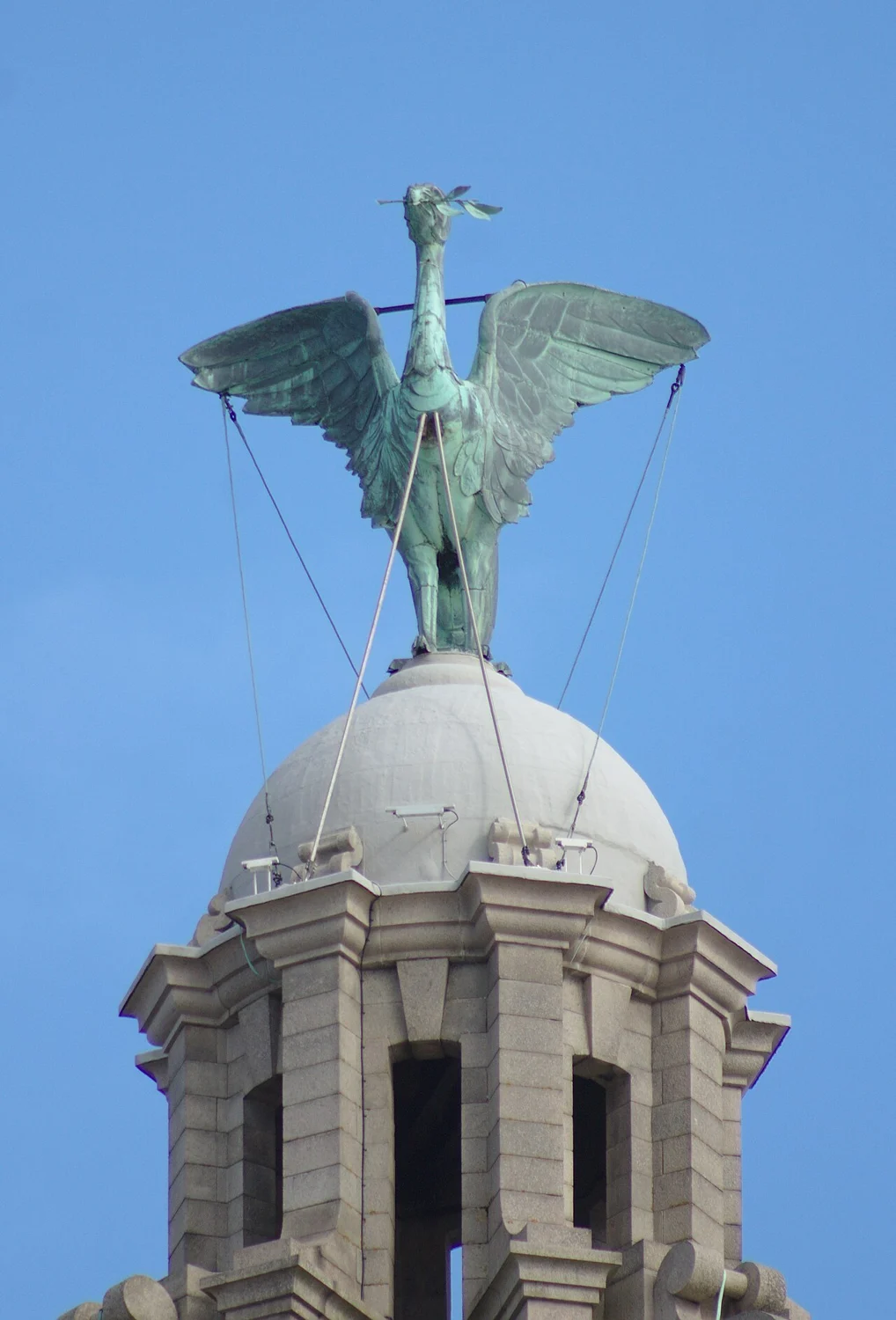
The rooftop birds were designed by Carl Bernard Bartels. Historic England’s account identifies the German sculptor and records his wartime internment on the Isle of Man. The Royal Liver Memories project describes his separation from his family, his removal to Germany after the war, his eventual return to England and the city’s posthumous recognition in 2011.
There is a hard contradiction here. The work could stand above the city as a symbol of belonging while its maker was treated as an outsider. You do not need to dress that up. Keeping Bartels in the story stops the birds becoming anonymous decoration and reminds us that a place’s identity is made by people who arrive as well as people born there.
Bella, Bertie and the business of a good story.
The pair are popularly known as Bella and Bertie. One faces the river, the other inland. The familiar explanation gives them protective duties over sailors and the city; the visitor attraction also repeats the legend that Liverpool would cease to exist if they flew away. That is folklore presented as folklore, not a building-survey recommendation.
A story can matter without being a historical fact. Names make the enormous birds familiar. The idea of watching departures and returns turns a rooftop ornament into a companion. The joke versions do something similar: they bring the skyline down to conversational height. Just do not quietly turn a modern retelling into a documented medieval belief.
Our position on the flight risk is that the city has enough to deal with already. Leave the birds where they are.
Then football got its hands on it.
Liverpool’s association with the city’s emblem and the date it appeared on a playing shirt are separate questions. In the club museum’s account of the 1950 shirt, the first bird-bearing strip was white, with the emblem inside a red shield. Prepared for the FA Cup final, it was actually worn at Portsmouth the week before Wembley. The bird reached the red home shirt in an oval emblem in November 1955.
That small distinction is the sort of thing an archive is for. “First worn for the cup final” is a tidy shorthand; the earlier league appearance makes it more exact. And no, the bird did not arrive on a red shirt with six European Cups already tucked under its wing.
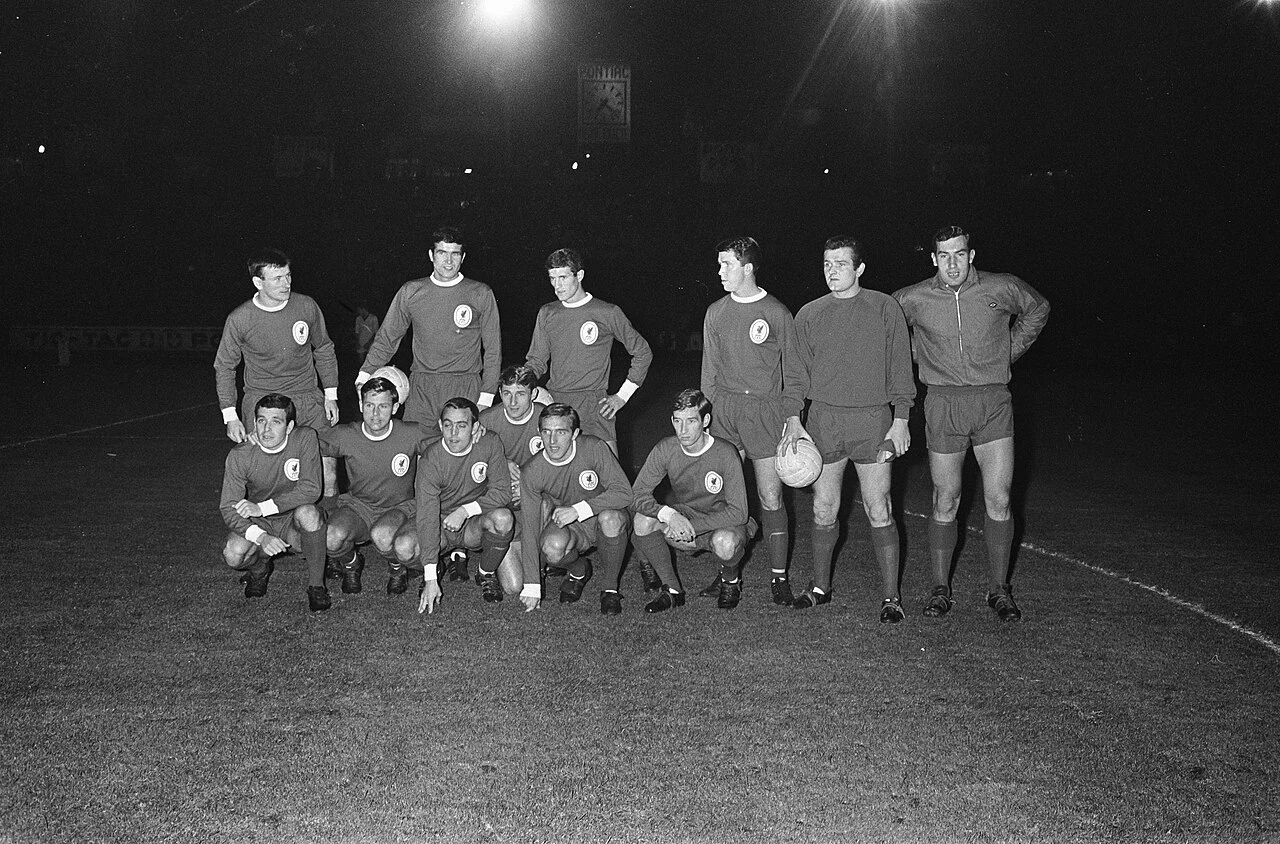
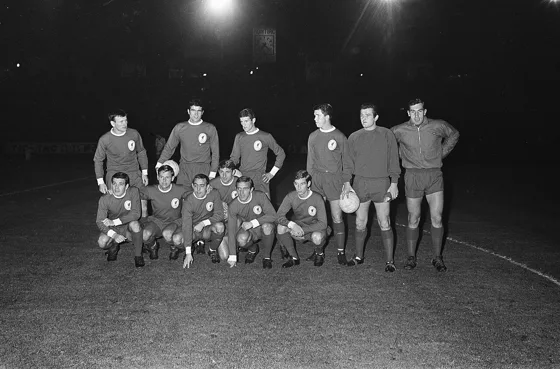
The 1966 team photograph is a later chapter, clearly dated in the archive. It gives the shirt story a human scale: a row of players wearing a symbol that had already travelled through civic seals and waterfront architecture. The change to the all-red look is another story with a detail worth checking before repeating it.
The bird now fits in your pocket.
For the 2024–25 season, LFC announced wider use of the simplified bird across digital platforms, explaining that it reads clearly on small screens while the fuller crest remains an official emblem. A subsequent design announcement described lettering and graphics inspired by its wings and talons.
From a seal pressed into wax to a shape legible on a phone: different machinery, a familiar problem. How do you make people recognise who is speaking? The club’s version carries particular football meaning. The city’s much older bird still has a life beyond it. Loving one does not require pretending the other is ours alone.
Look up. Then look closer.
Start at the waterfront and look at the relationship between the two towers, rather than trying to squeeze everything into one photograph. Then approach from Water Street. Compare the distant outline with the way the building appears between neighbouring façades. Leave room for the city around the icon.
Next time you find a Liver Bird on a civic object, a wall or a piece of old paper, ask three simple things: who made this version, what was it for, and what can actually be dated? You might end up with a better story than the one printed on a souvenir.
The bird can belong to a matchday and an ordinary walk home. To the supporter on the terrace and the person who never watches football. It is big enough for both. That is a better sort of civic pride than checking somebody’s scarf before letting them admire the skyline.
Reading & sources (11)
- Wikipedia: Liver bird — overview and references
- J. Wall: The Quest for the Liver Bird — Historic Society of Lancashire and Cheshire
- National Museums Liverpool: Liver Bird Trail
- Historic England: Royal Liver Building listing, 1356370
- Historic England: the building and Carl Bernard Bartels
- Royal Liver Building 360: the society and building timeline
- Royal Liver Memories: the building and Bartels
- National Museums Liverpool: Transatlantic slavery collection
- Liverpool FC: how the bird appeared on the 1950 and 1955 shirts
- Liverpool FC: the bird’s digital rollout for 2024–25
- Liverpool FC: the subsequent bird-inspired design refresh
Your bird. Your street.
Where is your favourite Liver Bird away from the football shirt? Share your own photograph, the street or building, and what you know about it.
Join the conversation →